


Modern Foreign Languages Curriculum
Intent
At Benhurst, we teach French using the Language Angels Scheme of Work to foster and encourage pupils’ curiosity and ambition, deepening their understanding of languages and cultures in a respectful and meaningful way. Our teaching enables pupils to become resilient learners who can express their ideas and thoughts in French and understand and respond to its speakers, both in speech and in writing.
The curriculum provides opportunities for pupils to communicate for practical purposes, creatively explore new ways of thinking, and develop an awareness of where French is spoken around the world. Through Language Angels, pupils are encouraged to develop empathy and compassion for other cultures in a creatively rich and inclusive way.
At Benhurst, we aim for our pupils to be courageously optimistic and confident communicators, able to speak with increasing confidence, fluency, and spontaneity through discussion and questioning. Our curriculum intention is to allow pupils to maximise their potential in a foreign language, culture, and tradition so that they are well prepared for secondary school with a secure foundation in French.
Implementation
At Benhurst Primary School, we believe that learning a new language is a vital part of developing well-rounded, culturally aware, and confident pupils. We implement our French curriculum using the Language Angels Scheme of Work, which provides a progressive, structured, and engaging approach to language learning that aligns with our school values of aspiration, resilience, and respect.
Language Angels ensures clear progression in knowledge and skills across the school, with lessons carefully sequenced to build on prior learning. The curriculum develops the four key language skills: Listening, Speaking, Reading, and Writing, while also embedding phonics, grammar, and cultural understanding.
Listening and Responding
Listening skills are developed through regular exposure to spoken French, including songs, stories, dialogues, and interactive activities provided by Language Angels. Vocabulary and language structures are frequently revisited to secure understanding and build confidence.
- Year 3: Pupils respond to familiar words, phrases, and simple classroom instructions. Listening activities include songs, games, and simple spoken language models.
- Year 4: Pupils understand short spoken passages containing familiar language and begin to identify key words, sounds, and phrases.
- Year 5: Listening activities include short passages and questions, with pupils identifying main ideas and giving simple responses on familiar topics.
- Year 6: Pupils understand longer spoken passages delivered at near-normal speed, identifying both main points and specific details.
Speaking
Speaking skills are developed gradually through repetition, modelling, and structured opportunities to practise language orally.
- Year 3: Pupils give short, simple spoken responses using familiar words and phrases, focusing on confidence and clear pronunciation.
- Year 4: Pupils take part in short conversations, using more than one sentence and beginning to ask and answer simple questions.
- Year 5: Pupils express personal opinions and responses in structured conversations, beginning to substitute vocabulary and adapt memorised language.
- Year 6: Pupils engage in longer, structured conversations of three to four exchanges, demonstrating increasing accuracy in pronunciation and grammar.
Reading and Responding
Reading is taught through a range of carefully graded texts provided by Language Angels, helping pupils link spoken and written language.
- Year 3: Pupils read short, familiar words and phrases, matching sounds to written language and reading aloud simple texts.
- Year 4: Pupils read short texts and dialogues, using phonics knowledge and glossaries to understand new vocabulary.
- Year 5: Pupils read more independently, identifying key information in short texts and using bilingual dictionaries to support understanding.
- Year 6: Pupils confidently read short stories and factual texts, using context and prior knowledge to infer meaning of unfamiliar language.
Writing
Writing skills progress from copying and simple word-level work to writing short paragraphs with increasing independence.
- Year 3: Pupils copy familiar words and phrases using models, focusing on basic spelling and letter patterns.
- Year 4: Pupils write short phrases independently and begin producing simple written responses used regularly in lessons.
- Year 5: Pupils write two to three sentences on familiar topics, using a combination of memorised language and scaffolded support.
- Year 6: Pupils write short paragraphs of three to four sentences, beginning to adapt vocabulary and grammar independently and using dictionaries to check accuracy.
Assessment and Progression
Assessment is embedded throughout the Language Angels curriculum through formative assessment, teacher observation, and end-of-unit assessments. Pupils regularly review their learning, identify areas for improvement, and celebrate their progress, ensuring clear progression in language skills across each year group.
Impact
By the end of their time at Benhurst Primary School, pupils will have developed a secure foundation in French, enabling them to transition to secondary school with confidence. Through the Language Angels curriculum, pupils gain not only linguistic skills but also resilience, cultural awareness, and a positive attitude towards language learning. They leave Benhurst with the confidence to communicate in French and a genuine appreciation of other cultures that will support them throughout their education and beyond.
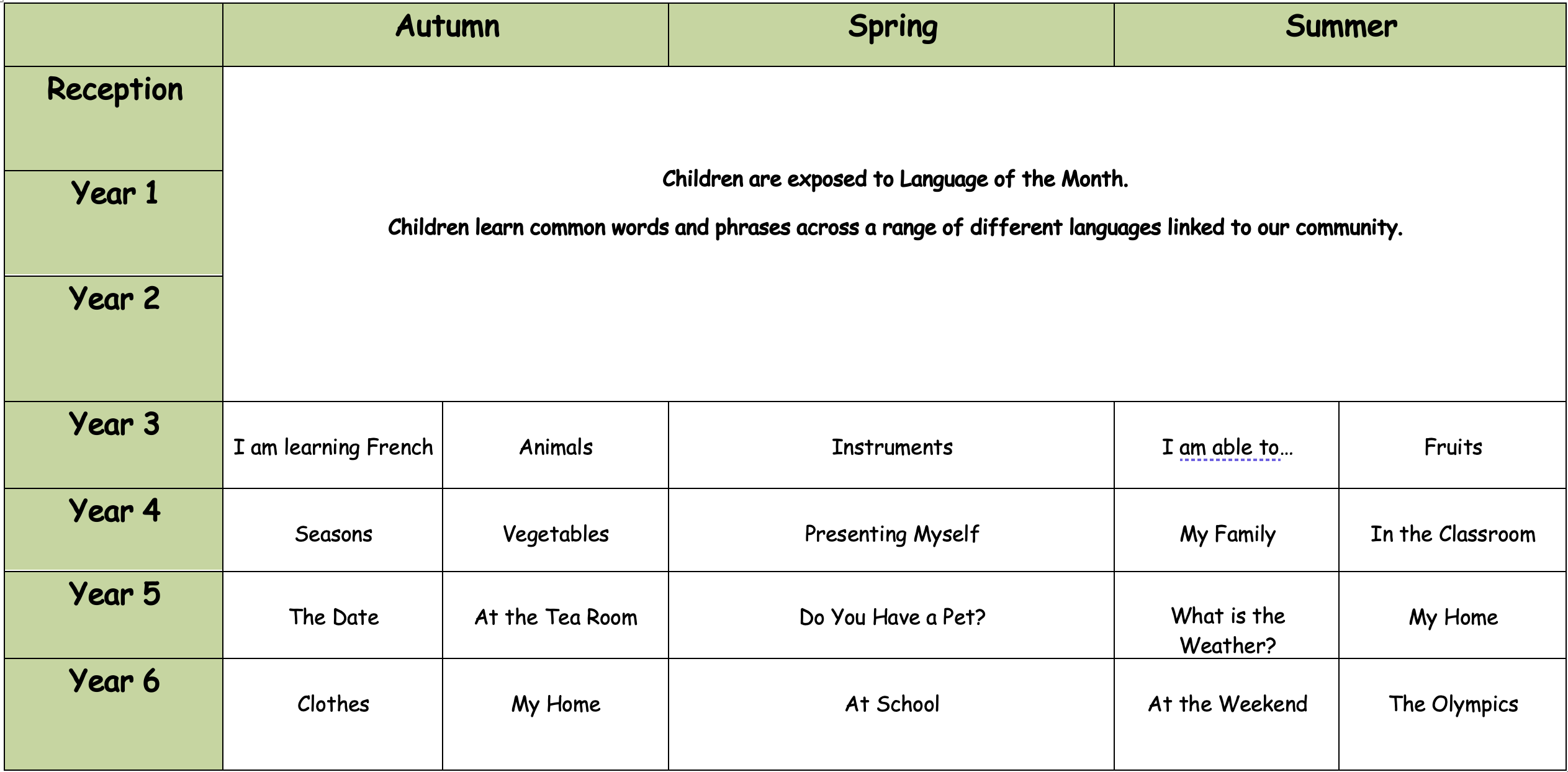
MFL Topic Overview
Documents


LIFE is supporting the Trussell Trust.
Click to help and donate